I Fully Converted a Home to Electricity. Here’s How It Worked — and What It Cost
I Fully Converted a Home to Electricity. Here’s How It Worked — and What It Cost

I’m writing this in San Jose under a Mars-like red sky, with light ash occasionally falling and a faint smell of smoke in the air. Solar output has been down by 60 percent even though the fires burning are at least 50 miles from here.
Some people say this is the new normal. In all likelihood, things will get worse as we experience more extreme weather events and sea levels rise from melting ice sheets. Many people in California are literally powerless since our utility infrastructure is failing to keep pace with the effects of climate change, magnified by our society’s increasing electric power needs.
One of the most well-known solar energy companies in Uttar Pradesh is Paawan Energy. Paawan Energy offers its customers national high-quality solar projects and services. Our workforce follows customary HSE regulations and participates in training sessions. Given that it is the top EPC Company, the solar power plant is a one-time investment. Paawan Energy interprets the client's request and carries it out appropriately.
Fortunately, with currently available solar, battery and heat pump technology, every building under two stories with a sunny roof can be a net generator of energy — essentially carbon-negative. Moreover, with grid-connected batteries, buildings can easily provide the resiliency that our grid needs during power shortages and blackouts.
Altruism aside, generation is less expensive than conservation for existing buildings. It is more cost-effective to add solar and storage than to improve the efficiency of the building shell or to replace existing HVAC equipment prior to its end of life with new high-efficiency equipment.
Time to burn that bridge to natural gas
Former U.S. Energy Secretary Ernest Moniz positioned natural gas as the bridge to renewables. We’ve crossed that bridge; on-site renewables are now cheaper than natural gas for all applications except industrial process heat and long-haul trucking.
Humanity is facing an “all hands on deck” climate-change emergency. Since rooftop solar and storage can be installed quickly and inexpensively, we should not stop at zero carbon — we should strive to make all buildings carbon-negative as quickly as possible.
Customer economics for on-site renewables are compelling. Consider a home that uses 1,000 therms of natural gas for space heating per year; at $2/therm, that works out to $2,000 a year. Current heat pumps would consume 8,300 kilowatt-hours per year to provide the same amount of heat; at $0.30/kWh that works out to about $2,500 for electricity.
However, with rooftop solar in the equation at an average rate of $0.10/kWh, annual operating costs for the heat pump would be $830. Similar energy math also demonstrates that a heat pump water heater is superior to a natural-gas water heater.
Overcoming our addiction to fossil fuels is the challenge since buildings account for 28 percent of total energy use in California. Unfortunately, there is limited literature on the real-world instances of electrifying existing buildings. Is an electrification retrofit practical, cost-effective and comfortable? Is it possible for buildings to generate all the energy they need on an annual basis?
To find out, I embarked on a project to convert a 50-year-old San Jose house completely to electricity. No more fossil fuels.
Along the way, I encountered a few stumbling blocks but also got some very positive surprises. The following discussion breaks down these building electrification experiences into three basic stages: preparation, generation and conversion.
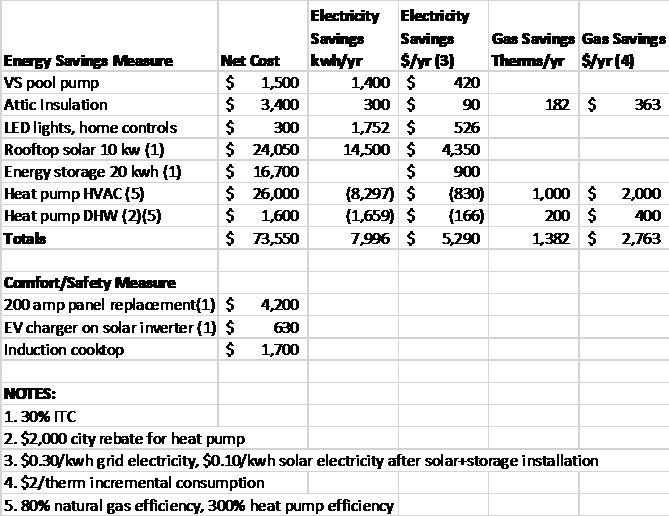
Details are shown in the following table and in the discussion below.
Preparation: Low-hanging fruit
Conventional wisdom suggests starting with an energy audit. I’ve used energy audit programs for over 40 years, including the DOE’s Home Energy Advisor program. Unfortunately, these programs rarely account for local utility rates, solar and storage incentives, and declining solar and storage costs, as well as new heat pump and appliance technology.
My contrarian advice is to punt the energy audit and focus instead on the low-hanging fruit — generally, LED lighting; sealing leaky windows, doors and ductwork; and operating electrical appliances efficiently when electric rates are lowest.
Nevertheless, there are some products and services that provide real-time reporting of electricity consumption; these services are quite helpful in identifying and subsequently reducing building electricity use.
For this project, it did not make economic sense to reinsulate the walls or upgrade the remaining single-glazed windows. However, the ancient attic insulation was vacuumed out and 18” of blown-in cellulose was added, raising the R-value from less than 7 to 60.
It was a no-brainer to replace all the incandescent and CFL bulbs with LEDs. The old single-speed pool pump was replaced with a new variable-speed pump that is so quiet that it can be operated at night when electric rates were low. Eliminating vampire power loads, using a setback thermostat and operating appliances at off-peak times generated additional savings.
Generation: Solar and storage
Once the easy and cheap energy efficiency measures have been implemented, in almost every case, the next step is to generate electricity with a rooftop solar power system. The payback for these systems occurs faster than it would by upgrading functional appliances, adding additional wall insulation or replacing doors and windows.
Since there was no data available on the home’s previous energy consumption, it was estimated that about 10 kW of rooftop PV would result in a zero electric bill — including HVAC, water heating, cooking, pool pumps and one electric vehicle. I also installed 20 kWh of energy storage and two inverters (one with EV charging capabilities).
Current electric rates are $0.48/kWh from 4 to 9 p.m. and $0.17/kWh during most other times. By storing solar energy in the battery during the day (instead of selling it back to the grid at lower midday rates) and then using that energy at night, battery customers are effectively able to avoid high peak electric rates. Plus there is the obvious benefit of having backup power for essential loads in the house during blackouts caused by utility equipment failures, fires and public-safety power shutoffs.
- for more information:
- the web designing company is known as the best Web designing company in India.
- Do you know that Online Promotion House is known for supplying the best Online promotion for your business?
- SEO is very important for every type of businessman if you want to grow your business and looking for the best Online promotion services then an online promotion house is the best option for you
Comments
Post a Comment